Es mostren els missatges amb l'etiqueta de comentaris catalonia. Mostrar tots els missatges

divendres, 23 d’abril del 2010

Sant Jordi 2010

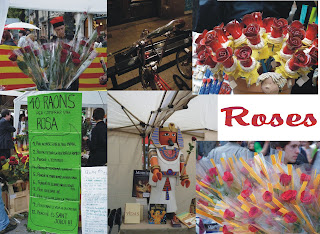
After my birthday on April 18th a very special day comes: Sant Jordi on April 23rd. For me one of the most beautiful celebrations we have in Catalonia. This Sant Jordi was half rainy, but this did not stop people going out and lingering on the streets, buying books and roses for friends, family and lovers.

Last year's St. Jordi I talked about the legend behind the day and how the day is celebrated (with some pictures). This year I will add some more pictures of roses, books which filled up the stalls and people crowding the streets of Barcelona, enjoying the day.

Roses

Llibres (books)


Gent (people)
Well-known personalities sign their book
(eg, second row left, Quim Monzó, and third row right, the famous cook Carme Ruscalleda)


If you ever happen to be in Catalonia for Sant Jordi, don't miss it, enjoy it! :)

Xavi and I with the traditional St. Jordi's gifts, a book and a rose

diumenge, 28 de març del 2010

Barça, Estrella Damm, Catalonia or everything? - Explanation

A few weeks ago I left some pending questions and explanation about a current beer ad which I posted precisely because it is, for me, much more than a mere beer ad. Let's look at the questions more deeply.

- What do you think of the ad?
Like MaryMoon and Isabel, I like the ad. I think that it is the job of good publicists and really creative. And the more I watch the ad, the more I see that it has multiple techniques that I could not appreciate at first sight and that make me think that it is not such a simple and ordinary ad.

Pretty interesting I found the comparison Derek makes. As he says, American beer ads seem to have a very particular structure and particular targets is a format we rarely see. Of course, there have been ads in this mood, like Budweiser ads during late nineties or early two thousand. But still, Budweiser is not an Spanish/Catalan beer and most time they had no spoken words or they were subtitled (the videos Derek linked on the comments made me think of them).

With this, I am not saying that Spanish/Catalan beer ads do not have an structure or a target. Indeed they have, but it is not the same as American beer ads. When I watch a Spanish beer ad, I do not feel it is targeted at 21-30, I rather feel anyone in the age of doing so can enjoy it. And more that being funny, I think they try to be original and ever-lasting, giving beer moderate consumption a high status. I wouldn't say something reserved to intellectuals though, I am more inclined to think that they try to appeal everyone. And this is the case of this particular ad.

I think it is targeted as everyone on legal age, using Barça to do so. The link appears so simple to me: lots of people like Barça, lots of people will like this beer. Barça is something great (the best team in the world!), this beer sponsors Barça, this beer MUST be great. I could go even further to give the nationalist sense I find in the ad, but this is answered in other questions and the link then can be easily established ;).

- Do you think it is a good beer ad?
Here I find divided opinions.

Well, I think it is a good ad and very original in its construction. It does mention the brand "Estrella Damm" but it gives more weight to Barça images and the poem, which I think is a good technique. You get the idea of the ad uniqueness (nothing of the kind before) and you can establish a connection with the brand it announces. Strictly, the product appears in the end, but the imprint of the ad is so deep that it makes you remember which brand did it and what it announced. This is, mostly, what Isabel pointed out.

I do not know if it is a good beer ad, though. Because...what is a good beer ad?

Other campaigns by "Estrella Damm" have been equally good and successful, like last summer ad with the song "Summercat" by the Swedish group Billie Vision & The Dancers, filmed in the Balearic Island of Formentera. The ad is the videoclip by this group and it incorporates images of Estrella Damm bottles. I recommend you watch it.

This summer ad used a complete new ad formula and it was successful. The ad I posted follows the same style and has been equally successful. So then...it must be a good beer ad...I think...

- Do you think it tells something to the (Catalan) audience?
Indeed. The poem tells people (Catalans) can achieve their goals, that nothing is impossible. I do not remember the Generalitat's campaign MaryMoon mentions, but I do see the positive turn the ad gives it.

- Does it tell something more to you, rather than just advertising beer?
It does tell something more if you can give it a context which allows interpretation.

- Do you like the ad text?
I agree to all of you. It is a nice lyric poem, craftily built. And combining it with music gives it a nice rhythm.
Isabel said that she liked he different accent it showcases. Well, she's come to my favourite subject :D and I feel the need to comment something about it.

The poem showcases differents accents but not dialectal accents. The general dialect is spoken standard Catalan. Most of the actors in the ad are professional actors or TV presenters and they speak in a quite neutral accent. Well, with the exception of the two cookers, which have the characteristic accent of Barcelona.

Probably, what Isabel noticed is the accents of non-Catalan people speaking Catalan, namely the young man working with wood and the boy in the skateboard. The young man is probably from Northern Europe (his way of pronouncing "r", his blue eyes and fair hair make me think it) and the boy is South-American (I would even venture Argentinian...)

- Do you think it is a nationalist ad?
There is a very good point that Anna made. She mentions that these ad might use football to convey national feelings. Indeed Catalans, may easily interpret it as such, but it is not the typical "we're good and the others aren't"; to use Isabel words, it tries to raise the spirits of Catalans. It is very easy to understand the poem as somehow nationalist and it make sense in a nationalistic frame.

On the other side, it could also make sense in a non-nationalist context (and hence, the "could be" in MaryMoon's comment. However, I am inclined to think the ad is indeed nationalist, and what is more, it represents, for me, an "inclusive" nationalism: some of the speakers are Catalan well-known actors or TV presenters and an also some non-Catalan people appear. Besides, there are all those images of Pep Guardiola and Barça players. The ad uses all this to convery that Catalans not only accept plurality, but also integrates it in the culture. And there is the music, which integrates more instruments every time and become more joyful. The feeling you have when you finish the ad is: Wow, WE are great! But you do NOT feel that others are not great as well.

Maybe I wouldn't agree with Isabel when she mentions that it can imply that independence can be reached, as I think the ad does not go so far and deep, as I said before I think it is not a separatist ad (note that I make a difference here between nationalism and separatism/independentism). But her interpretation makes perfect sense.

- Do you think it seems to mix things up?
No discussion on that ;). It mixes things up: football, beer, Catalan pride in its people and nation. And it does so in a positive way. And what is more: it has been craftily manipulated to seem "natural". Here I have a negative criticism on the ad: it can seem to build on the tendency to mix everything up. In Catalonia, as I said many other times, everything can have a sociopolitical turn. Look for example, at the insight MaryMoon does about Joan Laporta, current Barça president, who, taking advantage of Barça's achievements and position, has launched an independentist political campaign. I might agree to some ideas Laporta may have, but I do not approve his way of speaking them by mixing football and politics. Talking about it requires another post!

Well, I think this is it. I probably skipped some of the appreciations in the comments (hope you can forgive me :)...). Thanks for your collaboration!

dimecres, 3 de març del 2010

Barça, Estrella Damm, Catalonia or everything?

Today I'd like to share this ad with you:


Here is the translation:


Un equip de futbol
va ser el centre del món.
I quin és el secret?
Es preguntava tothom.

La velocitat, el control?
Anar sempre a l'atac?
Buscar sempre el gol?

És el joc en equip?
no serà la humilitat?
Sense protagonistes,
ni cap divinitat.

Un equip de futbol
va ser el centre del món.
I quin és el secret?
Es preguntava tothom.

La feina ben feta,
qui no ho recorda
una cosa molt nostra
en els moments de més glòria

Estimar el teu ofici,
vigilar cada detall,
va cantar en un poema
Joan Maragall.

Tot està per fer,
podem aixecar el vol.
Tot és possible,
escrivia Martí i Pol

Salvador Dalí,
Pau Casals,
Antoni Gaudí,
Des d'aquí universals.

La Ruscalleda amb la cullera,
amb la ploma el Monzó,
tu amb el teu martell
i jo, amb el meu ordinador.

Metges, periodistes,
mecànics, pintors,
fusters, lampistes,
músics i escriptors.

Un equip de futbol
va ser el centre del món.
I quin és el secret?
Es preguntava tothom.

La passió, la dedicació,
l'atreviment, la curiositat,
i estimar la feina
és la nostra creativitat.

Són les ganes, treballar fort,
Desperta company,
és millor que anar sol.

No ens hem de reinventar
Hem de seguir essent qui som,
fer les coses com sempre,
que no ens venci la son

Un equip de futbol
va ser el centre del món
I quin és el secret?
Es preguntava tothom

Si fem les coses
com nosaltres sabem
Hi ha res impossible
ho aconseguirem

I el que facin els altres
tant se val.
La feina ben feta no té fronteres,
No té rival.
A football team
was the centre of the world.
And which is the secret?
Asked everyone

Speed, control?
Be always striking?
Always aiming at the goal?

Is it team game?
can't it be humbleness?
No protagonists,
no master gods.

A football team
was the centre of the world.
And which is the secret?
Asked everyone.

A job well done,
who can forget,
a thing of our own
in the most glorious moments

Love your trade,
Care for every detail,
sang once in a poem
Joan Maragall.

Everything's to be done,
we can fly up.
Everything's possible,
wrote Martí i Pol

Salvador Dalí,
Pau Casals,
Antoni Gaudí,
From here, universal.

Ruscalleda with her spoon,
with his fountain pen, Monzó,
you with your hammer,
and I with my computer.

Doctors, journalists,
mechanics, painters,
carpenters, plumbers,
musicians and writers.

A football team
was the centre of the world.
And which is the secret?
Asked everyone.

Passion, dedication,
Audacity, curiosity,
and loving our job
is our creativity.

Being eager, working hard,
Wake up fellow,
it's better than being alone.

We mustn't reinvent ourselves
We must still be what we are,
do things as we always do,
do not let sleep defeat us.

A football team
was the centre of the world.
And which is the secret?
asked everyone

If we do things
as we know
Is there anything impossible?
We can do it.

And what other may do
it is not essential.
A good job has no borders,
It is unrivalled.


Now I'd like to ask you some things:
- What do you think of the ad?
- Do you think it is a good beer ad?
- Do you think it tells something to the (Catalan) audience?
- Does it tell something more to you, rather than just advertising beer?
- Do you like the ad text?
- Do you think it is a nationalist ad?
- Do you think it seems to mix things up?

I am interested on how you see the ad, especially if you are not Catalan (but Catalans are welcome too!). If you wish to do so, just comment on the post. Then, I will explain it and give my opinion on the next post. I hope you participate :)!

dimarts, 19 de gener del 2010

The eternal discussion

So far I have avoided politics as much as I could, mainly because a) I do not want to create trouble and conflict, b) I do not want to bore you, and c) I do not want to write a political blog. But I think I need to write lines on the sociopolitical discussions between Catalonia and Spain. Not saying a word without it would be like lying, denying a truth that exists and is very present -even in daily life. On the other hand it is a very delicate issue in which I have my own opinions, as everybody has in this country. Therefore, carefulness is needed to avoid offence.

The "battle" between Spain and Catalonia began long ago and will be still here for long. But why so? What happens exactly? Why these discussions exist?


For me the whole Spanish-Catalan question boils down to

1- Identity and feelings
2- Language
3- History
4- Miscomprehension

It seems easy when put into 4 points, but it is really complex!

I do not want to go further into detail today, but if you agree and you wish to learn some more things about it, I will give some insights from time to time, as objectively as I can.

dissabte, 12 de desembre del 2009

Smell of Christmas (I)... - Aim

Again, December. Again, time for perfume, chocolate, watches, Nespresso (¬¬) and cava (the Catalan version of champagne), ultrafrozen seafood and toys ads. Again, decorated fir trees. Again, those typical street lights. Again, everybody seems to be happy. Again, tradition is the rule. Again, Christmas is approaching.

Catalonia shares many Christmas traditions with the rest of Spain, but it also have traditions of its own. My aim during these special dates is to write about all these traditions (both the shared and the unique ones). This will be my particular way to share my Christmas with you.

I hope you like it :).

divendres, 11 de setembre del 2009

Hang out your flags!

This morning, I woke up by 9:15. Usually, by this time, I should be already in the office working. But today is a bank holiday. It's Catalonia's National Day.

History:
The curious thing about this date is that we remember the biggest defeat Catalonia had. Yes, we celebrate that we were on the losing side in the Spanish Succession War at the beginning of the 18th century, which supposed the end of many Catalan liberties in favour of a centralised government model.

But what was exactly the Spanish Succession War? It might seem that it was only an internal Spanish matter. But it wasn't: it also involved other European countries. Since the beginning of the 16th century, Spain had been reigned by the Habsburgs -or "Àustries", in Catalan- dinasty. They were a dinasty which came from Austria, or to be honest with history, from the Austria-hungary empire. However, in 1700 the then king Charles II died without offspring (he was always ill and he was mentally-retarded due to too close consanguity and royal endogamy). Then, succession matters started. Charles II was replaced by Joseph Ferdinand of Bavary, but he soon died too and the issue appeared again. Two kings claimed, for differents reasons, the throne to be legitimatily theirs: Philip of Bourbon and Charles of Austria.

Charles of Austria

Philip V of Bourbon

Catalonia took its position for Charles of Austria, probably because the Borbonic model was a centralised one, which would sure suppose the end of many priviledges it had (as it happened). Besides, Catalans had already had fought a war from 1640 to 1659. This war is known as "La Guerra dels Segadors" (The reapers' war), as it broke out in Corpus day (7 June 1640) when a group of Catalan peasants, armed with their sickles, entered the city of Barcelona and revolted against the count-duke of Olivares who represented the Spanish kingdom in Catalonia. Olivares had been abusing Catalans war resources for the war Castilla (Spain) was fighting against Borbonic France. There were too many troops on rural Catalonia, and the fields were devastated because of that. The peasants were indeed loyal to the then king Philip IV, but they were certainly annoyed to see their crops devastated, as this meant hunger. The war ended in 1659 with the Treaty of the Pyrenees, where Catalonia lost the now French area of the Roussillon, an up-to-then Aragonese-Catalan territory. What remains of this war in popular knowledge is the hymn of Catalonia, Els Segadors (The reapers)

La Guerra de Segadors breaks out (painting of 1907)

Well, after explaining why Catalonia took its sides with Charles of Austria, let's go back to what matters in this post. The Succession Wars broke out in 1701: Habsburgs against Bourbons. The war had also repercussions in Europe, therefore we can say it was an international war -well, to be honest, at the time Europe was in the hands of a few royal families who held power...so things were easily international matters.

War advanced and finally Borbonic troops won. Catalonia was severly punished. It was one of the last places to fall under Borbonic hands. But still, you might be wondering what the Catalan National Day has to do with that. Now that I covered the basis, let's come to the point (sorry, it is difficult to get to the point if you are not given the context first).

Towards the end of the Succession wars, by 1713 the Bourbons knew they had won (and they had the support of Borbonic France) and "invited" the city of Barcelona to surrender. Catalan institutions saw that surrendering would mean the end of their system, so they decided to resist. Troops were gathered and about one year later, Barcelona was placed under siege. It was a hard siege and resources soon finished. On 11th September 1714, Rafael de Casanova, the then head of Barcelona, had to surrender to Philip V's troops.

The siege of Barcelona

This defeat supposed, as I already pointed out, the end of Catalan institutions who were replaced by a heavy centralised system based in Madrid. The "Decretos de Nueva Planta" (The Nueva Planta decrees) were issued and Catalonia, as a losing side, was severely affected by them: not only Catalan institutions disappeared, but Catalan was not longer used in writing and of course , Catalans could not trade nor have a share in the wealth coming from Spanish Empire (or the "Americas") -note that this was the golden age of the Spanish Empire (in Spanish, "el imperio donde nunca se pone el sol" or in English"the Empire where the sun never sets").


Celebrations:
Luckily, things have improved (well, after other hardships like Franco's dictatorship). We have been granted back some rights than we had on that time. But still, there is a long way to walk.

So what do we do every 11th September?

-We hang out a Senyera (the Catalan flag) over the balcony or the window.

-There are institutional acts, the main one being the flower offering to the Rafael de Casanova monument in Barcelona by the Generalitat president, the mayor of Barcelona and other Catalan political figures.


-Go to el Fossar de les Moreres in Barcelona, where many of the fallen of the 1714 siege were buried.


-If you are a very revolutionary Catalan fighter, organize reivindicative acts or attend them.

-Dance sardanes, the typical dance of Catalonia.

-Go to the official acts held in the Plaça de la Ciutadella in Barcelona.

-On 10th September listen or pretend to listen the speech by the Catalan president on TV3.

This is the president of la Generalitat of the TV3 comic show "Polònia".
Right after the official speech yesterday, the fake president appeared
making its own particular discourse. I cracked with laughter :D.

-Sing or listen the Catalan hymn "Els segadors" (right hand in the heart). When you listen to the lyrics it a very violent song related to the reapers who rebelled and related to rural life.


-Simply chill at home or take advantage of the day, or if it falls near the weekend, just take a mini-holidays. Like many people does and I am going to do: I'm leaving for the weekend with the 15.00 h train to Valencia. I feel Catalan, but I do not think doing all the above will make more Catalan, at the end all these acts are political and I must confess I am quite disappointed with Catalan politicians.

divendres, 21 d’agost del 2009

The team that touched the sky


There was a day, not so long ago, where the whole world was blue and red, or as we say here "blaugrana". That was on May 28, the day after Football Club Barcelona (Barça, from now on) beat Manchester United in the Champions League final in Rome. In the Eternal City, Barça proved to be currently the best football team on Earth. This already was in every supporter's mind, but the match in Rome was the best climax possible to a season that has amazed everybody, from the local fan to the distant African supporter.

SEASON 2008/09: A REPORT OF DAYS TO REMEMBER
The season did not begin very well, but the team never gave up working. By the end of the season, the time when I began to like football, the situation had completely changed. I enjoyed the classic match Real Madrid-Barça, with the impressive result of 2-6. What I do not like much is the too strong feeling against Real Madrid that some Barça supporters have.

I was also amazed at the in-extremis goal by Iniesta that shuttled Barça to the Champions League final in Rome. The serious faces of people turned into jumps of happiness at minute 92. We had almost done it. There is a very funny and original recording from RAC1 broadcasting of the match when Iniesta made the goal (click on first audio player to listen to it). Though you may not understand it, you will clearly feel the craziness and uniqueness of the moment. This was on May 7.

And, above all the matches, I keep a very special memory of the Copa del Rey final against Athletic de Bilbao. I had never seen such modelic supporters. I think the heroes of the match were Athletic de Bilbao's supporters, which gave us a lesson of how to encourage your team, no matter it lost the match. They were the winners of the night. I would not have been sad if they had won the cup. Next day after the match I read lots of comments of support coming from Barcelona in a Basque newspaper. One, which came from a father in Barcelona, was specially touching: 'Thanks to you (meaning the "Athleti" supporters), yesterday I could teach my son what football really is'. Also you could read "Athleti is my second team".

After some more days, Barça won the League. Firecracks began to illuminate the city. Canaletes, the fountain in the Rambla of Barcelona where Barça's victories are celebrated, was filled massively for the second time in the season, not without the complaints of the neighbours in the area.

Getting to Canaletes in les Rambles, May 16th

And finally, the 27th May final in Rome came and Barça did it! Veniamus, vidimus, vincimus! (We came, we saw, we won) And they played well! Canaletes was so full my friends and I didn't get to the fountain itself because it was crowded! Firecracks till crazyness. You couldn't escape Barça's fever. The city, the whole of Catalonia and even the wind was whispering the name of the team. It didn't matter you had school or had to work the next day.


This video was broadcasted by the TV3 show "Crackòvia", which makes fun of sport in Catalonia and Spain. The video shows Barça players who sing a song about winning the three titles. The song was broadcasted around St. Jordi,-and reference is made to the festivity in the video- , when it was still unknown if Barça would win the three trophies. This curious version of "We will Rock You" is a very well-known song now. The song starts at minute 1:50.

Celebrating the triplet with friends

After this extasis, on May 28, the most famous newspapers in the globe showed pictures of the team and waving blue and red flags. In the afternoon half of the population in Barcelona (750,000 people) went out on the street to see their idols parading on a roofless double-deck bus. It was something I had never seen before and it just left me speechless.

The team's parade in Plaça Catalunya, Barcelona

"MÉS QUE UN CLUB"
This may give you an idea about what Barça represents for its supporters, especially Catalan ones. In fact, Barça is more than a simple sports club, that is "més que un club".

To start with, it is not all about winning matches and titles (and a lot of money). It is about the spirit with which they were won. Barça is the team who touched the sky also because of its coach, Pep Guardiola, a man who at his young age (38), set the team to work enthusiastically. He made them believe nothing is possible without an effort, that you can win only thanks to team work, that every player has its own value for the team, that one should never give up and that fair-play is the rule. No one thought he could do that at the beggining of last season -not even himself- and now he's probably the most talked-about coach all over the world. He taught a lesson on how to play good football. Besides, his are values for kids to learn (some schools in Catalonia actually used him as an example).

The team and Guardiola (photo from El Periódico)

Guardiola is precisely a further example of what the team stands for. During the last years, Barça has made a difference in the way it gets its players. They eventually buy star players, but their usual modus operandi is taking young boys around the world who outstand in their street football games. These kids are brought to "La Masia" in Barcelona, where they are trained and ultimately become players in the team.

And now comes the tricky part. As most things in Catalonia, Barça does not escape politics. The sports club is usually associated with Catalanism (ie, Catalan nationalism), for better or worse. This idea comes directly from the times of Franco's dictatorship, when Catalan language and culture were banned from the public sphere. In those days Barça became a symbol for the Catalan democrats fighting against Franco. Nowadays, more than thirty year's after Franco's death, Barça and Catalonia are two concepts which are still tightly associated. Of course not all Barça supporters defend Catalanist ideas and not all Catalans are Barça supporters. For instance, some follow the other big club in Barcelona, RCD Espanyol, and others follow other local or national teams.

An example of how politics and sport are entangled: this boy is wering a Barça scarf,
an independentist Catalan flag and a T-shirt which reads
"A nation, a selection" (for the creation of a Catalan sports selection)


One thing for sure, the intertwinning between football and politics in Spain is a complicated mess to disentangle: Real Madrid and Athletic de Bilbao are mixed with politics too. Real Madrid stands for Spanish nationalism and Athletic de Bilbao only hires Basque players. Competivity, thus, for some is political too. It might be hard to understand why this happens and maybe, I don't know, it is difficult to imagine for you. After all, football is only a sport, one that moves an awful lot of money, but still a sport and as such it should be meant as something to have fun with.

There is only one thing left to say: now that the new season has just began, get ready and enjoy it!

dimarts, 26 de maig del 2009

A beautiful landscape

Last Tuesday a new weekly TV programme began in TV3 -the public Catalan television channel. It is called "El paisatge favorit de Catalunya" (The favourite landscape of Catalonia).

It aims at letting users choose which is their favourite landscape by voting. In each programme, three famous public personalities who live in Catalonia talk about their favourite landscapes and encourage people to vote for it. Besides voting, people can also post their own pictures of Catalan landscapes in the programme's web.

I also see another aim as well: make people in Catalonia know their own land. And believe me, there is so much to see!

I was captivated, moved by the beauty of the images. We have a treasure: a land which offers us every kind of landscape: mountains up to 3140 metres, rocky coast, sandy coast, hills, rivers, pintoresque villages, medieval towns, a big city, volcanos (inactive...and hopefully extinct), plains... A bunch of possibilites and wonders!

I see one weak point in this programme: it is so hard to say which is my favourite landscape in Catalonia!

You can watch the programme in TV3's website. They will upload every week 's programme, so anyone can watch it after it is broadcasted. The only thing is that is narrated in Catalan, but landscapes speak no languages, so I invite you to enjoy it. I hope you like it.


dissabte, 13 de desembre del 2008

The basics: let's put things into place -geographically.

Catalonia is a region of Spain, a country in Southern Europe. It borders with the Mediterranean sea in the east, with France and Andorra (a little country in the heart of the Pyrénees about which I will also talk about in this blog) in the North, with Aragón and the Valencian community (other regions of Spain) in the west and in the south, correspondingly .


To say that this description will suit everyone is lying. But why? Because of the first six words: "Catalonia is a region of Spain". It is indeed a region of Spain according to laws and international treaties and all the worlds, understands Spain as a unit, a solid country. But the truth is that Spain is not such a unit. Spain is a diverse country, not because of its different and beautiful landscapes but because inside it, there are what we call "historical regions". This regions, which are, according to common law (the Constitution), Galicia, the Basqueland and Catalonia. Each of them has a language of its own and in the past they had been independent from Spain (until the 15th century). Besides, 19th century Europe saw the rise of nationalism, which attracted Catalan intellectuals of the time. This, among with some other things, make some Catalans feel that they do not belong to Spain. But more of it in another post. Let's focus on geography now :).

Now that the geographical limits of Catalonia have been established, I would like to talk about how is Catalonia internally divided.


As any other part of Spain, Catalonia is divided into provinces. The four Catalan provinces are: Girona, Barcelona, Tarragona and Lleida. The capital city of these provinces bear the same name.


The provinces are further divided into what is called "comarques" (a kind of counties), which have, as in the case of provinces a capital city. Logically, the most populated of these capital cities becomes the province's capital.


dijous, 4 de desembre del 2008

Welcome letter / Carta de benvinguda

Dear reader,


I welcome you from a place called Catalonia. What is this place? Where is it located in the world's map? Maybe if I tell you a key word you will easily spot it: Barcelona. So, here you have the relationship: Barcelona, the ‘cool’ city for Erasmus students and seat of the Olympic Games in 1992, is in Catalonia, a region in the north-east of Spain. But we will talk about geography later, because it is not free from its own geopolitical problems.


First of all I would like you to tell you who I am, what I do and why I decided to begin this blog. Well, my name is Anna (a pretty universal name) and I am 24. I was born in the Empordà area (in the north-east of Catalonia, bordering with France) but I live and work as a translator in Barcelona. I am passionate about languages and culture. That is the main reason why I write this blog. I like all languages, but I have a special feeling towards my own language and culture: Catalan. Besides, I feel there is a lot of miscomprehension and misunderstanding around them, or ideas which I deem as wrong or full of bad intentions. These ideas hurt me. My aim is to present my language and culture as something worth of interest (as any other subject) and, if possible, make you like, appreciate and understand them. I do no wish to be unrespectful or to give my opinion in a rude way about the polemic political battle there is in Spain because of that.


In this blog you will find all that is related to Catalonia:

- Geography and demography (where is Catalonia located, landmarks, facts and figures)
- History (a journey through time)
- Travelling (places of interest, ideas for little trips around the land)
- Literature (authors and books)
- Art (what are our most international artists, theatre, music, cinema)
- Traditions (monographic posts about one aspect of our traditions
- Gastronomy (what we eat and what we cook)
- Politics (a tricky subject)
- Language (all about the Catalan language)


Please, feel free to comment or ask what you like to know.


I hope that you enjoy it and that, one day or another, you will visit this curious land called Catalonia.


Thanks for your interest and best wishes, or as we say in Catalan, “Una abraçada”,


Anna