When was it that I last played it? Regularly, more than seven years. Occasionally, perhaps four or five. So, this morning, I picked it up again. I took it out from its hippy leather case and I saw it again. My gralla. It was a present for my (16th?, 17th?) birthday. My father had bought it for me because he had liked what it was made of: olive tree wood. I can remember that when I first took it out of the case it smelled like olive oil and wood mixed together.
 My gralla and its case
My memory went back to 1997, when I first set my fingers on a gralla. In the village, there were other people that had been playing it for one or two years and they patiently taught me the basics. Later on, I took private lessons until I did not feel like playing it anymore (as a teenager, sometimes it felt like an obligation).
We rehearsed in what had been the old nursery school of Vilafant once a week, Saturday from 3 pm to 4 pm, just after lunch. We were not professionals and did not aim at it, but we liked to play. Without the company of the timbal and the caixa, the gralla felt lonely. So, these two percussion instruments were also essential in the music played. So, there was always a timbal and a caixa playing with us.
We rehearsed to prepare street parades that took place mainly in the spring and the summer. We were part of a bigger group of people called COLLA GEGANTERA (literally, "The giants group"). A colla gegantera is a group of people that carry and accompany the two gegants (giants): two big papier-mâché figures up that usually represent the traditional life of a specific village. But this is a whole post in itself... so for now, let's focus on the gralla.
The gralla is a traditional and typical Catalan music instrument. It doesn't have a translation other languages, not in Spanish either. It has been speculated that its origin has a connection with snake enchanters who play that special flute that seem to cast a spell on snakes. But I do not know if this is possible or not. What is certain is that it is often confused with a very similar instrument called dolçaina (in fact my first step into the gralla world was playing a dolçaina).
The gralla was named after a bird (in English, the name for the gralla bird is "jackdaw"), as its strident sound reminds the song of this bird. Indeed, the instrument has a very peculiar loud sound and it should be this way, as it is a street instrument.
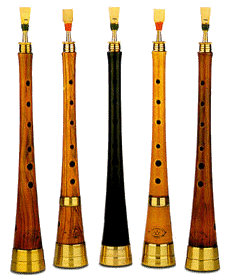 Different gralles
Technically, it is a wind instrument and the playing mechanism is that of a flute: it has 6 holes on the front and one hole at the back, plus two extra holes at the bottom sides that only used to let more air out. Playing music with it consists in opening and closing holes using the fingers. To blow it, you need to use an "inxa" (a reed). To prevent the reed from breaking lips are pushed slightly to cover the teeth (how many reeds did I tore learning how to blow it properly!).
After playing the instrument is usually humid and it needs to be cleaned, which is easily made with a special feather duster (like the ones that come with a flute) and the inxa and the reed holder, called "tija" (a kind of holding-tube) can be separated from the main body to dry.
One of the first difficulties for beginners is that the gralla is tremendously difficult to blow and it is easy to run out of breath. The lips also hurt after a while and begin to tremble, making a funny sound which sounds like a fart. But if you insist a little bit and don't get discouraged, you can easily play for 1h-1h 30 without having much trouble.
 My gralla and its case
My memory went back to 1997, when I first set my fingers on a gralla. In the village, there were other people that had been playing it for one or two years and they patiently taught me the basics. Later on, I took private lessons until I did not feel like playing it anymore (as a teenager, sometimes it felt like an obligation).
We rehearsed in what had been the old nursery school of Vilafant once a week, Saturday from 3 pm to 4 pm, just after lunch. We were not professionals and did not aim at it, but we liked to play. Without the company of the timbal and the caixa, the gralla felt lonely. So, these two percussion instruments were also essential in the music played. So, there was always a timbal and a caixa playing with us.
We rehearsed to prepare street parades that took place mainly in the spring and the summer. We were part of a bigger group of people called COLLA GEGANTERA (literally, "The giants group"). A colla gegantera is a group of people that carry and accompany the two gegants (giants): two big papier-mâché figures up that usually represent the traditional life of a specific village. But this is a whole post in itself... so for now, let's focus on the gralla.
The gralla is a traditional and typical Catalan music instrument. It doesn't have a translation other languages, not in Spanish either. It has been speculated that its origin has a connection with snake enchanters who play that special flute that seem to cast a spell on snakes. But I do not know if this is possible or not. What is certain is that it is often confused with a very similar instrument called dolçaina (in fact my first step into the gralla world was playing a dolçaina).
The gralla was named after a bird (in English, the name for the gralla bird is "jackdaw"), as its strident sound reminds the song of this bird. Indeed, the instrument has a very peculiar loud sound and it should be this way, as it is a street instrument.
 Different gralles
Technically, it is a wind instrument and the playing mechanism is that of a flute: it has 6 holes on the front and one hole at the back, plus two extra holes at the bottom sides that only used to let more air out. Playing music with it consists in opening and closing holes using the fingers. To blow it, you need to use an "inxa" (a reed). To prevent the reed from breaking lips are pushed slightly to cover the teeth (how many reeds did I tore learning how to blow it properly!).
After playing the instrument is usually humid and it needs to be cleaned, which is easily made with a special feather duster (like the ones that come with a flute) and the inxa and the reed holder, called "tija" (a kind of holding-tube) can be separated from the main body to dry.
One of the first difficulties for beginners is that the gralla is tremendously difficult to blow and it is easy to run out of breath. The lips also hurt after a while and begin to tremble, making a funny sound which sounds like a fart. But if you insist a little bit and don't get discouraged, you can easily play for 1h-1h 30 without having much trouble.
Playing the traditional song "El ball de la civada"
(after not having played the gralla for a long long time)
(after not having played the gralla for a long long time)
Bonus videos: the gralla is not that easy to blow :P
I can't believe there was a time when I could play this for 1h 30...
Keep on trying and maybe you'll get the note...


